


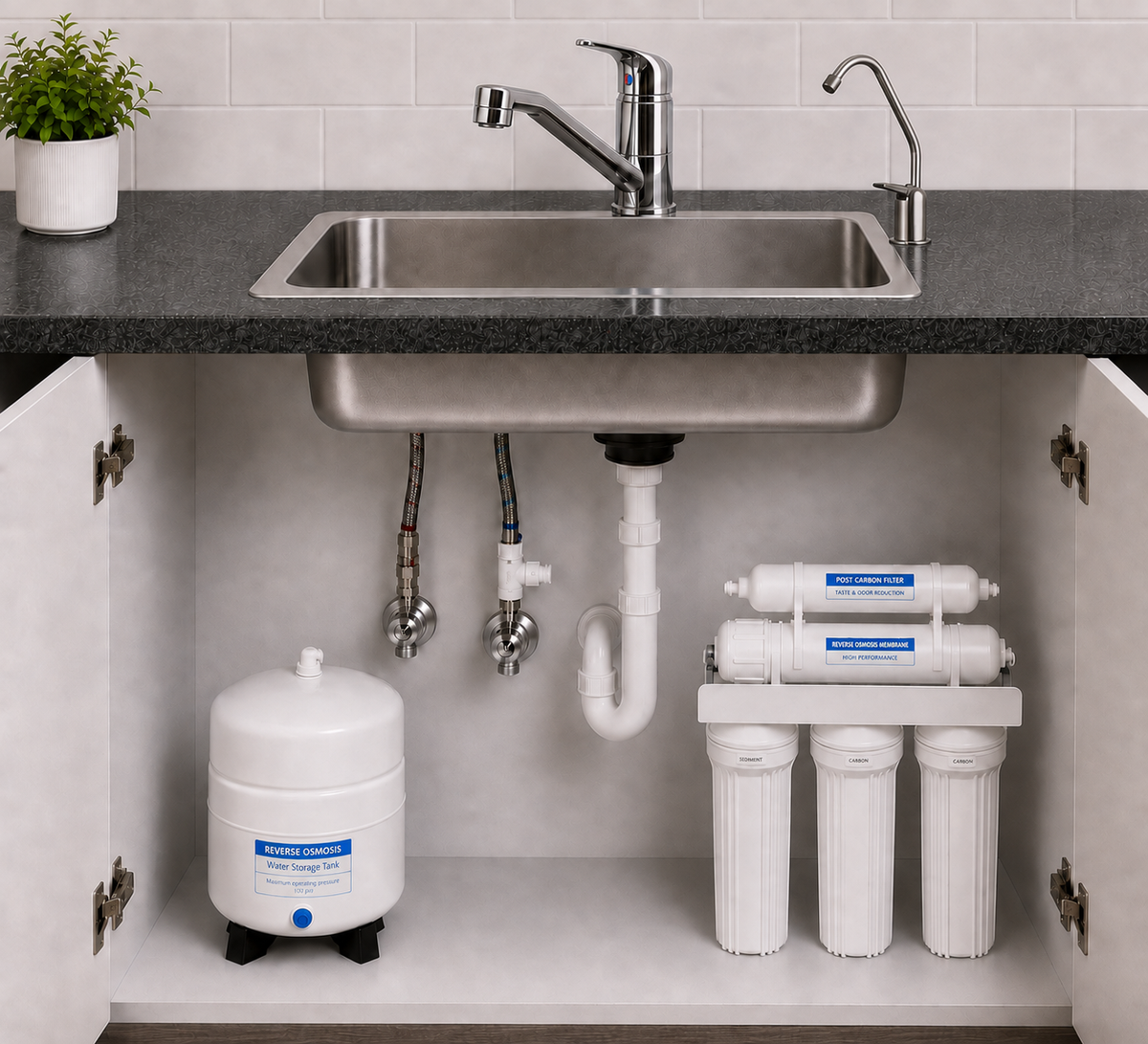
Kitchen water filters generally come in two shapes: one that disappears into the cupboard and does its job out of sight, and one that sits right there on the bench where you can see it working. Most people comparing the two end up focused on filtration power, when the real difference between an under-sink and countertop water filter has far more to do with your kitchen layout, your tenancy situation, and how much plumbing you're willing to take on.
That's really what an under-sink vs countertop water filter NZ decision comes down to. Bench space, renting versus owning, and how permanent you want the setup to be will usually matter more than the technology inside either one. We'll cover both properly below so you can work out which fits your household.
Under-Sink Filters: The Basics
An under-sink system, sometimes called an underbench filter, lives inside the cupboard beneath your sink and connects directly to the cold water supply, feeding either a dedicated filtered-water tap or your existing one depending on the model. Once it's installed, the filtration unit disappears from view entirely, which a lot of households prefer for a clean-looking kitchen, and because different cartridges target different concerns, the same physical setup can be configured for chlorine, fluoride, scale, alkalinity, or a combination through a multi-stage build. Our underbench systems range covers compact single-stage options right through to full bacteria-removal setups.
Countertop Filters: The Basics
A countertop filter, or benchtop unit, sits out in the open on your kitchen bench and usually connects to the tap through a diverter valve rather than the plumbing itself, which makes it the more approachable option if you'd rather not touch the pipework at all. Swapping cartridges tends to be quicker too, since the whole unit is right there rather than tucked away in a cupboard, and this is largely why benchtop filters have earned such a solid reputation among renters, given that nothing about the setup requires permanent changes to the property. Our benchtop systems collection includes options built for exactly this kind of flexible use.
| Feature | Under-Sink | Countertop |
| Location | Inside the cupboard | On the kitchen bench |
| Bench space | Stays clear | Takes up some space |
| Installation | More involved, may need plumbing access | Generally simpler, connects via diverter |
| Appearance | Hidden from view | Visible on the bench |
| Cartridge access | Requires opening the cupboard | Easy, right at hand |
| Rental-friendly | Depends on the specific install | Usually a safe bet |
| Filtration range | Wide | Wide |
| Best suited to | Permanent kitchen setups | Flexible or short-term living situations |
Installation and Space: What to Expect
Under-sink systems need access to the plumbing beneath your sink, and some setups call for a dedicated filtered-water tap alongside the existing one, so depending on your comfort with basic DIY, that might mean a professional installation rather than a weekend project. Countertop units sidestep most of that entirely, connecting straight to the existing tap with nothing to fit inside the cupboard, and if you ever want to move house or simply relocate the filter to a different tap, that becomes a five-minute job rather than a plumbing exercise.
The trade-off runs in the opposite direction once you consider storage rather than installation. An under-sink unit keeps your bench completely clear but eats into cupboard space, which matters more if that cupboard is already doing double duty for cleaning supplies and bins, while a countertop filter leaves the cupboard untouched but claims a permanent spot on the bench, a bigger deal in a small kitchen than a large one. Families with generous bench space rarely notice a countertop unit sitting there, whereas renters or apartment dwellers juggling a tight kitchen often lean under-sink for exactly the opposite reason, provided the landlord is on board with the install.
Does Location Affect Filtration Quality?
Not particularly, and it's worth being upfront about that. What actually determines filtration performance is the cartridge and system inside, not whether the housing sits under the sink or on the bench, since chlorine and taste issues, sediment, fluoride, scale, and bacteria are all addressed by specific cartridge types regardless of placement. A well-matched countertop system will comfortably outperform a poorly matched under-sink one, so it makes more sense to choose based on what's actually in your water and what you want removed, then decide on placement once you know which cartridge combination you need.
Which Suits Your Household?
Homeowners planning to stay put for a while often lean toward under-sink for the neat, long-term result, while renters and anyone wary of permanent changes tend to find countertop filters more practical simply because there's nothing to undo when the lease ends. Larger family kitchens usually have enough bench and cupboard space that the decision comes down to preference rather than necessity, though it's still worth thinking about daily water usage and cartridge capacity rather than choosing on looks alone, since a household running through several litres a day will burn through a cartridge faster no matter where the unit sits.
Maintenance and Cartridge Replacement
Replacement frequency depends on the specific system, your water quality, and how much you're running through it, so we'd rather not quote a single blanket timeframe that won't hold for every household. What matters more is keeping track of your own replacement intervals and not waiting until the water starts tasting off or the flow visibly slows, since that usually means the cartridge is well past due. Our replacement filter cartridges range covers carbon, sediment, and specialist options across both under-sink and countertop systems.
What About Cost?
Purchase price alone doesn't tell the full story, so it's worth factoring in the filter system itself, the cartridge, any tap or fitting, and installation costs where a plumber is required, then weighing that against the ongoing cost of replacement cartridges over time. Under-sink systems can carry a higher upfront cost when installation is involved, while countertop units are often cheaper to get running but may need cartridge changes more frequently depending on the model, so neither is consistently the cheaper option long-term. It really comes down to how much filtration you need and how long you intend to keep the system in place.
How to Choose the Right Kitchen Water Filter
- Know your water source. Mains, tank or bore water can each call for different filtration.
- Decide what you want to reduce. Taste, odour, sediment, fluoride, scale, or bacteria all point toward different cartridges.
- Check your available space. Bench space against cupboard space, and be honest about which one you can actually spare.
- Think about installation. A permanent setup or something you can connect and remove easily.
- Consider your household's water use. A couple's needs look very different to a busy family's.
- Check cartridge availability. Make sure replacements are easy to source before you commit to a system.
- Check the flow rate and specifications. Don't choose on appearance or price alone.
Whichever way you lean, the best kitchen water filter NZ households can rely on is the one that matches your actual water, your kitchen, and your everyday routine, rather than whichever option looks better in a product photo.
FAQs
Under-sink or countertop water filter, which is better?
Neither wins outright. Under-sink suits a permanent, hidden setup with more bench space freed up, while countertop suits anyone wanting a simple, movable install with easy cartridge access.
Is an under-sink water filter worth it?
For households planning to stay in a property long-term and wanting the unit out of sight, yes, it's generally worth the extra installation effort involved.
Are countertop water filters good?
They can be very effective, since filtration quality comes down to the cartridge inside rather than the fact that the unit sits on the bench instead of in the cupboard.
Do countertop water filters need installation?
Only a light touch, usually just connecting the diverter valve to your existing tap, with no plumbing access or cupboard fitting required.
Do under-sink water filters need a plumber?
Sometimes, depending on the system and your comfort with basic plumbing, some households manage it themselves while others prefer to bring one in for the connection.
Is an under-sink or benchtop filter better for a rental?
Countertop filters are generally the safer bet for rentals, since they avoid any permanent changes to the plumbing that a landlord might object to.
Find the Right Kitchen Water Filter
We stock both underbench and benchtop systems, along with replacement cartridges and a range of filtration options built around specific contaminants rather than a one-filter-fits-all approach. Not sure which setup suits your kitchen? Get in touch, and we'll help you match a system to your water and your household.