


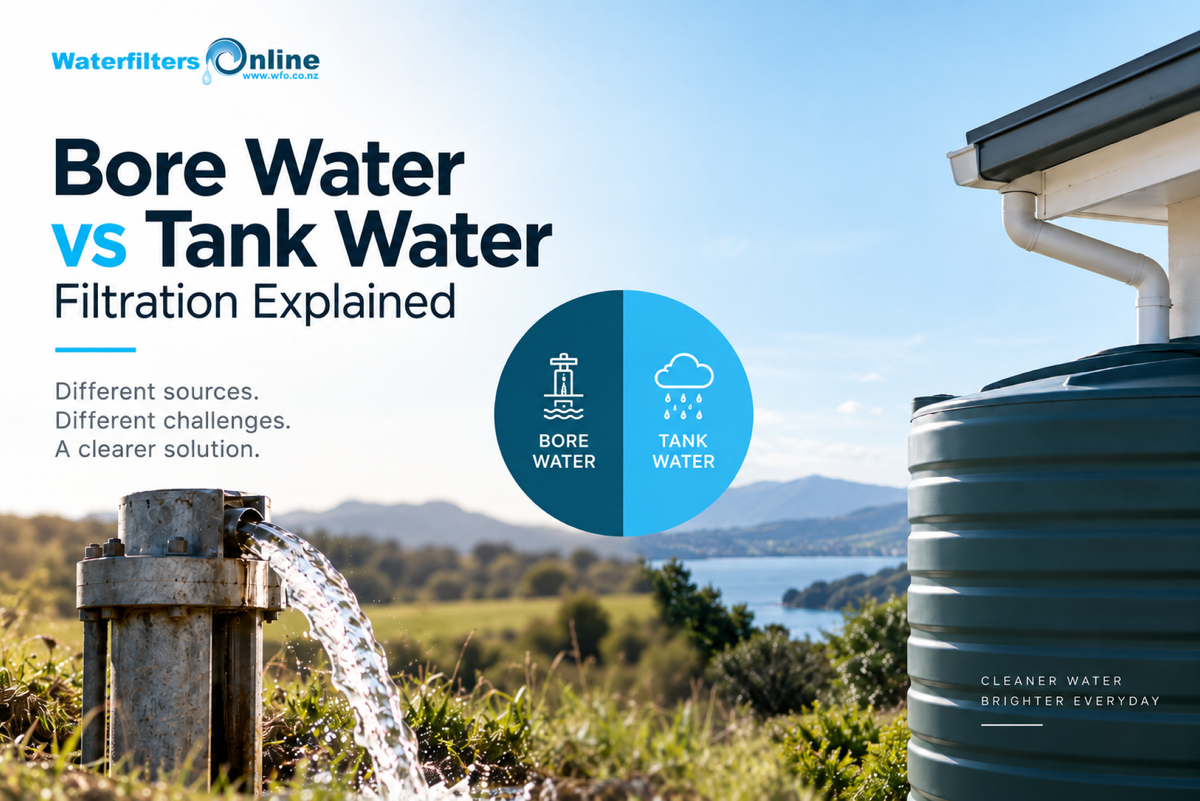
Your water runs cloudy after a heavy downpour, or it’s had a faint metallic edge for months, and you’ve just gotten used to it. Maybe you’re buying a property with a bore on it, and nobody can tell you what’s actually coming out of the ground. Untreated water has a way of raising questions nobody prepared you for, and the answers change depending on whether that water climbed up from an aquifer or fell out of the sky onto your roof.
Bore water and tank water start from completely different places, which is exactly why they can develop completely different problems. Here’s the part most people get wrong, though: the fix has less to do with which source you’re on and everything to do with what’s actually sitting in that water once it reaches your tap. Get the bore water filtration NZ properties need in place, or the tank equivalent, and you’re solving the real issue instead of throwing a generic filter at a guess.
Bore Water vs Tank Water: What’s the Difference?
Sorting out bore water vs tank water starts with understanding where each one comes from and what that means for treatment.
| Bore Water | Tank Water | |
|---|---|---|
| Source | Groundwater drawn from an aquifer | Collected rainwater |
| Main considerations | Minerals, sediment and naturally occurring contaminants | Sediment, organic matter and contamination during collection or storage |
| Quality varies based on | Local geology and groundwater conditions | Roof, gutters, tank condition and surrounding environment |
| Filtration approach | Depends on what's present in the bore water | Depends on the collection system and water quality |
Quality on either source can swing wildly between neighbouring properties. A bore twenty metres from someone else’s can sit on entirely different geology, and two tanks fed by identical roofs can collect very different debris depending on nearby trees or how often the gutters get cleared.
What Typically Ends Up in Each Source
Bore water may carry sediment, iron, manganese, dissolved minerals that contribute to hardness, nitrate, or microbial contamination, depending on local geology and groundwater conditions. None of that is a checklist every bore ticks off. Some run clean for years, others show elevated levels of just one or two of these from the outset, which is exactly why we’re wary of generalising on a health-adjacent topic.
Tank water tells a different story. It picks up whatever travels off the roof and through the guttering on its way into storage, commonly dirt and sediment, leaves and organic matter, bird or animal contamination, and fine particles that settle at the bottom over time. How well the collection and storage system is maintained tends to matter more than the rainfall itself. Clean gutters, a properly fitted first-flush diverter and a decent lid go a long way further than most people expect.
Does Bore or Tank Water Actually Need Filtration?
Neither source comes with a fixed answer. It comes down to the quality of that specific supply and how you intend to use it; a bore feeding an irrigation line has very different requirements to one supplying a kitchen tap, and the same logic applies to a tank. Testing removes the guesswork: sediment points toward sediment filtration, certain dissolved contaminants call for something more specialist, microbial concerns are usually handled through disinfection such as UV where the setup allows for it, and taste or odour issues are where activated carbon earns its keep.
Getting bore water filtration NZ properties actually need right from the start saves money on trial and error later. We stock sediment, carbon and UV-related filtration products, along with complete systems built for different water sources, so there’s generally a sensible starting point once you know what you’re working with.
Filtration Options Worth Knowing About
Sediment filtration reduces suspended particles before they reach the rest of the system, whether that sediment is coming up through a bore or settling in a tank. We carry cartridges across a range of micron ratings, from coarser options through to finer filtration for smaller particles.
Activated carbon helps with certain taste, odour and organic compounds, though results vary depending on the cartridge and the contaminant involved. It performs a similar role regardless of whether the water started underground or on a roof.
UV treatment disinfects water where microbial contamination is a genuine concern. It isn’t a catch-all fix on its own and works best paired with proper pre-filtration ahead of it, something worth checking before installing UV on either a bore or tank supply.
Multi-stage and whole-house systems combine several of the above in sequence, sediment first, then carbon or UV further down the line, which suits properties dealing with more than one issue at once or wanting treated water at every tap rather than just one. Our whole house and tank systems range covers setups built specifically for bore and tank-fed properties.
Which Source Needs More Filtration?
Neither one automatically needs more than the other. What matters is the contaminants actually present, the condition of the source, and how the water gets used day to day. Bore water isn’t automatically the “dirty” option, and tank water isn’t automatically “clean” just because it fell from the sky. Testing beats assumption every time.
How to Choose the Right System
Whether you’re weighing up bore water filtration NZ-wide or sorting out tank water filtration NZ households rely on for rainwater collection, the process below applies either way.
- Identify your water source. Bore, rainwater tank, mains, or something else entirely.
- Test your water. This tells you what’s actually there rather than what seems likely.
- Decide how it will be used. Drinking only, general kitchen use, whole house, or something specific like irrigation.
- Match filtration to the problem. Avoid picking a cartridge simply because it’s marketed as general-purpose.
- Check the flow rate. Whatever system you choose needs to keep up with the property’s actual demand.
- Maintenance plan. Replacement frequency depends on water quality and usage, which is why our replacement filter cartridges range covers sediment, carbon, and other applications as they wear out.
Test Before You Buy
Where water quality is uncertain, testing first is the sensible move rather than an optional extra. Skip it, and homeowners tend to run into the same handful of problems: buying the wrong filter, over-treating water that didn’t need it, under-treating water that did, replacing cartridges unnecessarily, or missing the actual contaminant altogether. A basic kit from our water test kits range is a low-cost way to sidestep all of that.
Common Mistakes
- Choosing a filter before testing the water
- Assuming one filter removes everything
- Using the wrong micron rating for the sediment involved
- Ignoring flow-rate requirements when sizing a system
- Forgetting ongoing filter maintenance
- Treating the source rather than the actual water quality issue
- Assuming bore and tank water need identical setups
- Installing UV without proper pre-filtration in place
Matching Symptoms to a Filtration Stage
| If your water shows | Consider |
|---|---|
| Cloudiness or visible particles | Sediment filtration |
| Off taste, odour or organic compounds | Activated carbon |
| Signs of microbial contamination | UV disinfection (with pre-filtration) |
| Elevated minerals or hardness | Specialist filtration matched to test results |
| Several issues at once | Multi-stage or whole-house system |
FAQs
How do I filter bore water?
Start with a water test, then build up from there: sediment first if particles are an issue, carbon for taste or odour, and UV only where microbial contamination is confirmed.
How do I filter tank water?
Much the same process as bore water: test first, then layer in sediment, carbon or UV based on what the results actually show rather than assuming every tank needs the full setup.
Which is easier to filter, bore water or tank water?
Neither is consistently easier. Bore water problems tend to be more stable once identified, since they’re tied to geology that doesn’t change much. Tank water can fluctuate more with the seasons and how well the collection system is kept.
What’s the best filter for bore water, and does the same apply to tank water?
There isn’t a single best filter for either. Sediment, carbon, UV, or a multi-stage combination may all play a role, and the right mix should be based on what testing shows up in your specific supply rather than a generic recommendation.
Can one system treat both bore and tank water?
Some multi-stage and whole-house systems are flexible enough for either source, though the exact configuration should still follow your test results rather than an assumption about which source is “harder” to treat.
Do I need to test my water before installing any filter?
Ideally yes. It’s a small upfront step that saves you from buying a system that doesn’t match the actual problem.
Getting the Filtration Right for Your Water Source
Bore water and tank water come from genuinely different places, so it makes sense they can throw up different challenges. But there’s no single bore water filter or tank water filter that suits every property regardless of what’s actually in the supply. Understanding your water quality first, then choosing a system built around those specific results, gets you a far better outcome than shopping by source label alone.
Which setup suits your water needs? Getting bore water filtration NZ right, or sorting a rainwater tank system, starts with a proper look at what’s actually in your supply. Browse our range of filtration systems and replacement filters, or get in touch with our team for help choosing the right configuration. We stock complete systems suited to mains, tank and bore water applications, alongside replacement sediment, carbon and specialist cartridges for whatever you’re already running.